In January 2023 I formally completed my double master’s degree: the MSc in Systems, Control and Robotics at KTH Royal Institute of Technology (Stockholm, August 2021 – January 2023) and the MSc in Telecommunication Engineering at the ETSIT, Universidad Politécnica de Madrid (UPM) (September 2020 – January 2023, finished with a 9/10) — earned with one single thesis that was accepted by both universities, defended in autumn 2022.En enero de 2023 completé formalmente mi doble máster: el MSc in Systems, Control and Robotics en el KTH Royal Institute of Technology (Estocolmo, agosto 2021 – enero 2023) y el MSc in Telecommunication Engineering en la ETSIT, Universidad Politécnica de Madrid (UPM) (septiembre 2020 – enero 2023, acabado con un 9/10) — con una única tesis aceptada por ambas universidades, defendida en otoño de 2022.
A double degree sounds exotic, but it is a surprisingly elegant mechanism: ETSIT-UPM runs 30 international double degrees with partner universities across Europe, Asia and the US, and instead of writing one thesis per programme, you write one — supervised by researchers from both sides — and it counts for both degrees. My own single thesis was the Digital Twin Knowledge Graphs for IoT Platforms degree project, carried out entirely at Ericsson Research.Un doble título suena exótico, pero es un mecanismo sorprendentemente elegante: ETSIT-UPM tiene 30 dobles títulos internacionales con universidades socias de Europa, Asia y EE. UU., y en vez de escribir una tesis por programa, escribes una — supervisada por investigadores de ambos lados — y vale para los dos títulos. Mi tesis única fue el Digital Twin Knowledge Graphs for IoT Platforms, realizado íntegramente en Ericsson Research.
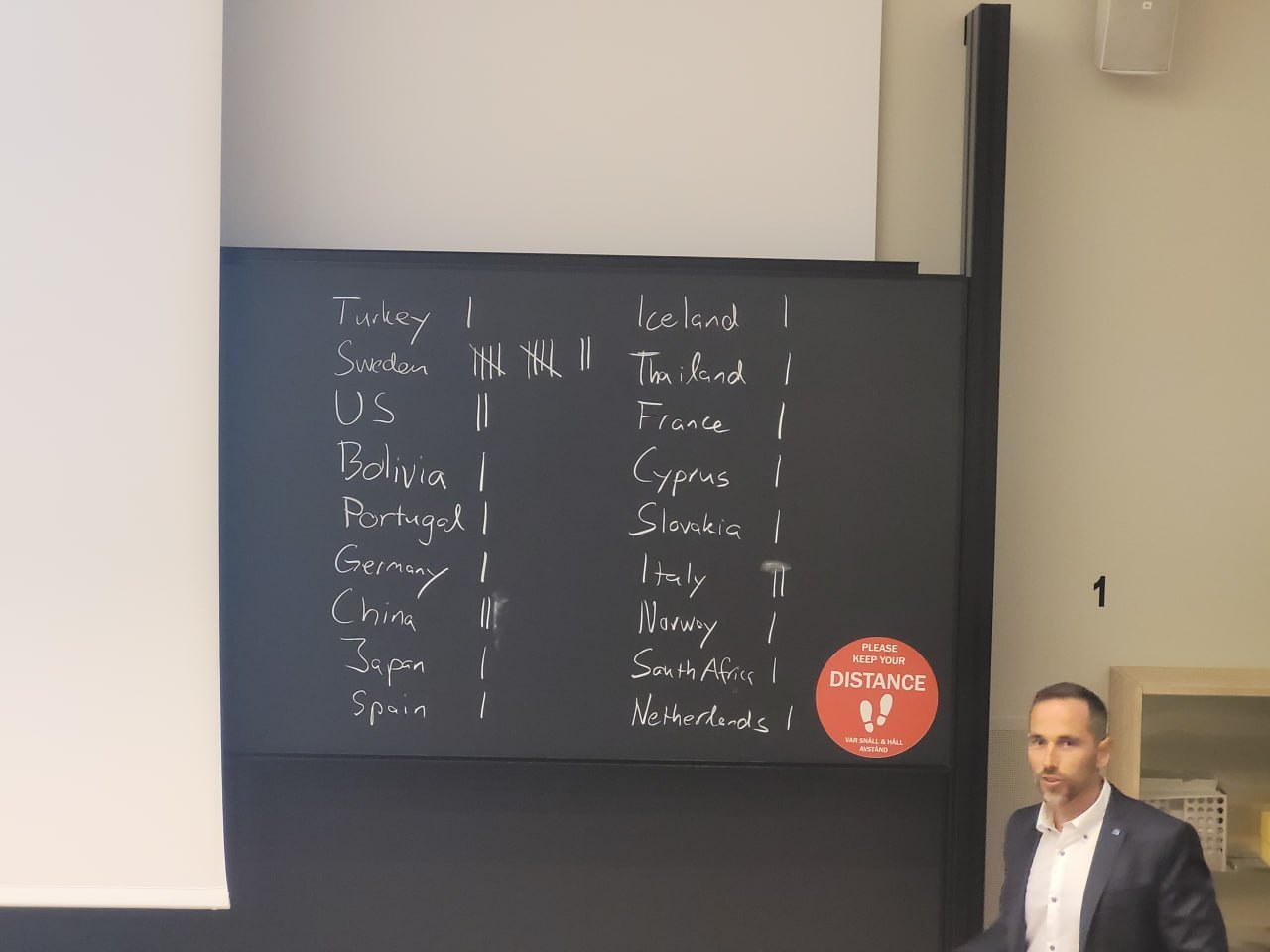
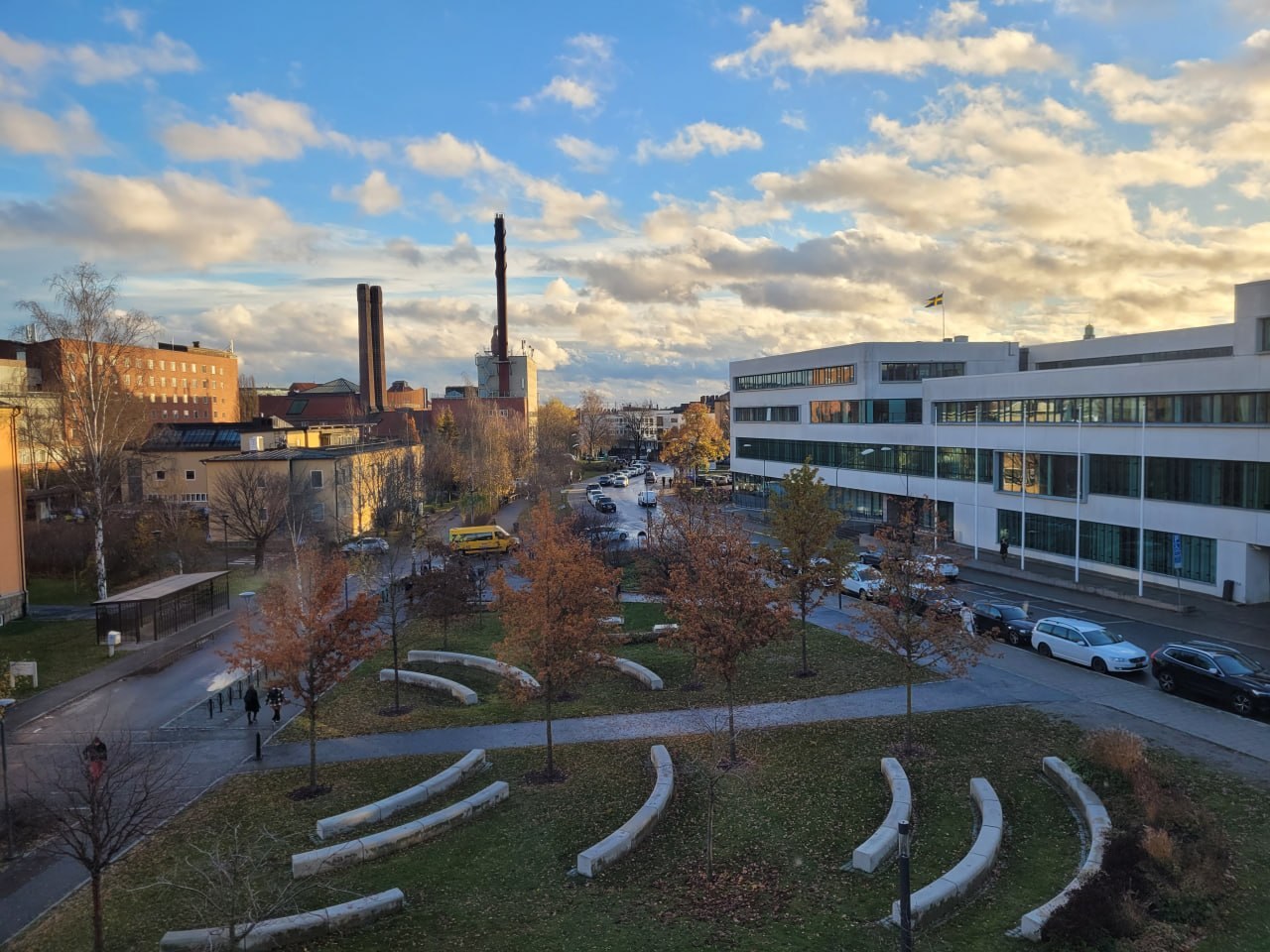
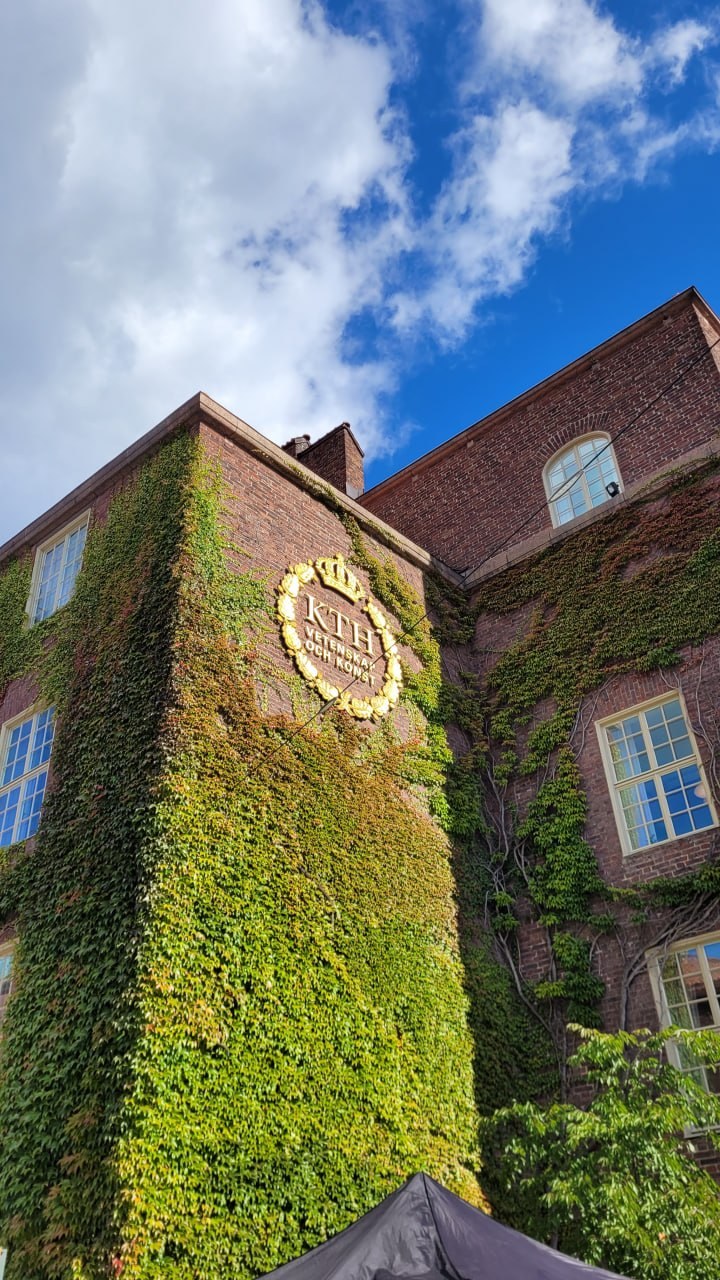
📸 KTH scenes📸 Escenas de KTH
Stockholm in 2021–2023: an international classroom (the tally of nationalities on the board — Sweden dominates, and Italy is proudly marked with π), autumn campus walks, and the ivy-covered KTH main building with its “Vetenskap och konst” crest.Estocolmo 2021–2023: un aula internacional (recuento de nacionalidades en la pizarra — Suecia domina, Italia con orgullo con π), paseos otoñales por el campus y el edificio principal de KTH cubierto de hiedra con el escudo “Vetenskap och konst”.
🎓 The two programmes🎓 Los dos programas
KTH — MSc Systems, Control and Robotics: a master focused on the analysis, design and control of robots, autonomous vehicles and other complex technical systems, with specialisations in autonomous sensing, AI, machine learning, decision making and control. This is where I learned to think in state spaces, feedback and estimation — and where the robotics thread of my career started.KTH — MSc Systems, Control and Robotics: máster centrado en analizar, diseñar y controlar robots, vehículos autónomos y sistemas técnicos complejos, con especializaciones en autonomous sensing, AI, machine learning, decision making y control. Aquí aprendí a pensar en espacios de estados, feedback y estimación — y empezó el hilo robótico de mi carrera.
ETSIT UPM — MSc in Telecommunication Engineering (MUIT): the telecom engineering master at Spain’s top telecommunications school, covering advanced communications, networks and signal processing — and the degree that formally qualifies you as a Telecommunications Engineer in Spain.ETSIT UPM — MSc in Telecommunication Engineering (MUIT): el máster de telecomunicaciones de la mejor escuela de telecomunicaciones de España, con comunicaciones avanzadas, redes y procesado de señal — y el título que te habilita como Telecommunications Engineer en España.
The double degree is structured so you study part of the programme at each university, and the mobility year abroad replaces a year at home — one diploma from UPM, one from KTH, one shared thesis in the middle.El doble título se estructura estudiando parte del programa en cada universidad, y el año de movilidad en el extranjero sustituye a un año en casa — un diploma de UPM, uno de KTH, una tesis compartida en medio.
🔧 The single thesis, at Ericsson Research🔧 La tesis única, en Ericsson Research
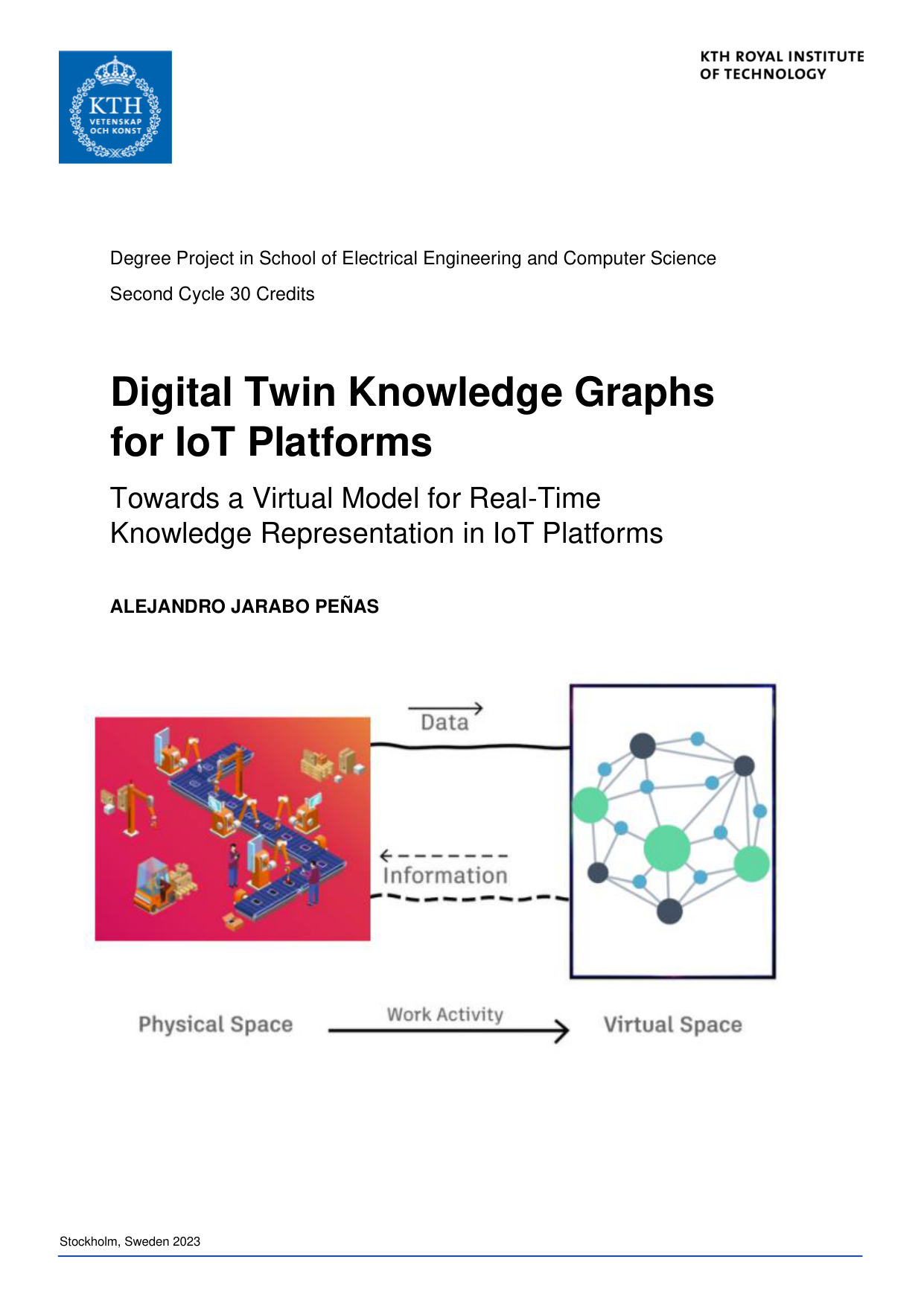
The degree project — Digital Twin Knowledge Graphs for IoT Platforms: Towards a Virtual Model for Real-Time Knowledge Representation in IoT Platforms (30 ECTS, School of EECS at KTH) — was developed as a 7-month internship (June – December 2022) in the Ericsson Research IoT and Cyber-Physical Systems department. Concretely, I designed a client that listens to the flow of messages from IoT devices in a network and processes those messages automatically in real time to build a virtual model based on a knowledge graph. The purpose of that knowledge graph is to provide meaningful insights about the platform’s status — insights that help optimize its behaviour and react against potential issues quickly. It tackled the “semantic-telemetry divide”: bridging the static semantic models of IoT platforms with the live time-series telemetry of real devices, so a digital twin can reason about its physical counterpart in real time.El degree project — Digital Twin Knowledge Graphs for IoT Platforms: Towards a Virtual Model for Real-Time Knowledge Representation in IoT Platforms (30 ECTS, School of EECS en KTH) — fue un internship de 7 meses (junio – diciembre 2022) en el departamento IoT and Cyber-Physical Systems de Ericsson Research. Concretamente, diseñé un cliente que escucha el flujo de mensajes de los dispositivos IoT de una red y los procesa automáticamente en tiempo real para construir un modelo virtual basado en un knowledge graph, cuyo fin es dar insights sobre el estado de la plataforma — insights que optimizan su comportamiento y reaccionan rápido ante problemas. Atacó la “semantic-telemetry divide”: unir los modelos semánticos estáticos de las plataformas IoT con la telemetría time-series de los dispositivos reales, para que un digital twin razone sobre su contraparte física en tiempo real.
The team behind it:El equipo detrás:
- Dr. Bin Xiao — Ericsson Research, Department of IoT and Cyber-Physical Systems (industrial supervisor)Dr. Bin Xiao — Ericsson Research, Department of IoT and Cyber-Physical Systems (supervisor industrial)
- Prof. Bo Wahlberg — KTH EECS, Division of Decision and Control Systems (academic supervisor)Prof. Bo Wahlberg — KTH EECS, Division of Decision and Control Systems (supervisor académico)
- Prof. Pedro J. Zufiria — ETSIT UPM, Department of Applied Mathematics (academic supervisor)Prof. Pedro J. Zufiria — ETSIT UPM, Department of Applied Mathematics (supervisor académico)
- Prof. Cristian Rojas — KTH EECS, Division of Decision and Control Systems (examiner)Prof. Cristian Rojas — KTH EECS, Division of Decision and Control Systems (examinador)
One thesis, three supervisors from industry and academia on two campuses, one examiner — and in the end two degrees. The full technical deep-dive — the knowledge-graph architecture, the semantic integration experiments and the embedding-matcher benchmark — lives in its own blog post.Una tesis, tres supervisores de industria y academia en dos campus, un examinador — y al final dos títulos. El deep-dive técnico completo — la arquitectura del knowledge graph, los experimentos de integración semántica y el benchmark embedding-matcher — está en su propio blog post.
The complete thesis is uploaded here, and it is also published in KTH’s DiVA repository:La tesis completa está subida aquí y también publicada en el repositorio DiVA de KTH:
MSc-Thesis-KG-IoT-Digital-Twin.pdf · DiVA record (diva2:1769438)
Thesis PDFThesis PDF KTH DiVA KTH · Systems, Control and Robotics ETSIT UPM · MSc Telecommunication Engineering ETSIT UPM · Double Degrees KTH × UPM · Ericsson Research